
Music
At Houghton Primary School, our aims and vision for Music, alongside those stated in the National Curriculum, are to:
- Develop an understanding of the breadth and diversity of music, and its links to our cultural heritage.
- Develop pupils’ understanding of how music reflects and responds to historical, geographical and religious contexts.
- Promote a growth mindset and support wellbeing through opportunities to experiment, make choices, practise mindfulness, and express individual ideas and opinions.
- Make meaningful links between music and future career pathways.
- Develop pupils’ skills in both solo and ensemble performance, fostering confidence, collaboration and a sense of community.
- Develop skills in singing, playing, listening, composing and performing through the use of a wide range of stimuli and instruments.
- Foster emotional, spiritual and personal responses to the music pupils hear and create.
Music has strong links with religion and spirituality. Music is regularly used in collective worship to enhance stories shared in assemblies and to celebrate important events and festivals such as Christmas, Easter and Harvest. Our Christian vision, ‘Love one another as I have loved you’, is reflected within music through opportunities for pupils to celebrate each other’s achievements, offer encouragement, and inspire one another through performance and collaboration.
Music promotes our learning characteristics by:
- Encouraging children to be curious about the sounds they can create using instruments, technology and their own voices and bodies.
- Ensuring all children participate in singing, listening, composing and performing opportunities.
- Developing problem-solving skills through composing, improvising and experimenting with sounds to achieve a desired outcome.
- Fostering perseverance when learning new skills and combining these to create and refine musical pieces.
- Encouraging reflection on compositions and performances so that pupils can identify successes and consider next steps for improvement.
Music provides rich opportunities for cross-curricular learning and can be used to stimulate discussion and deepen understanding in subjects such as History, Geography, Religious Education, Art and Physical Education. Connections are made where appropriate to help pupils see the relevance of music across the wider curriculum. Our 20th Century Music unit, studied across the school, exposes pupils to a diverse range of musical genres from different cultures, countries and time periods. In PE, music supports the development of rhythm, pulse and timing, helping pupils to enhance their dance performance and movement skills.
From Year 2 onwards, pupils have opportunities to learn a variety of musical instruments, enabling them to develop performance skills and musical confidence. Children regularly perform to audiences through class assemblies, concerts and school productions. Opportunities include Christmas performances, Harvest and Christmas church services, and Key Stage 1 Nativity productions. Older pupils also perform at community events within the village, helping them to develop confidence, pride and a sense of belonging while making a positive contribution to the local community.
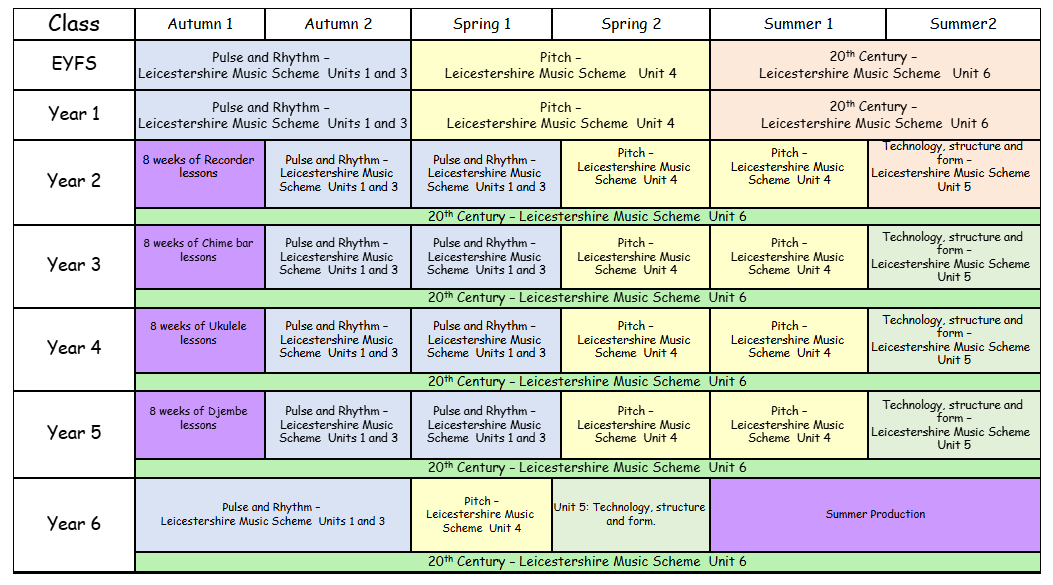
Music is taught through the Leicestershire Music Primary Scheme of Work. The curriculum is structured around five units that are studied from Foundation Stage through to Year 6. Each year, pupils revisit and develop their understanding of pulse, rhythm, pitch and music technology, enabling them to build upon prior learning and deepen their musical knowledge and skills as they progress through the school.
Music history is woven throughout these units, with pupils regularly listening to and appraising a wide range of significant musical works and songs. This is further enhanced through a dedicated unit exploring a variety of artists, genres and musical styles from the twentieth century. Pupils are encouraged to discuss and evaluate the music they hear, developing their ability to express and justify their opinions and preferences using appropriate musical vocabulary.
New units are introduced through a range of listening, exploration and practical activities, supported by discussion, modelling and teacher guidance. Pupils then apply their knowledge and skills through a sequence of performance, composition and appraisal activities. Self-assessment and peer feedback are integral to the process, supporting pupils in refining and improving their work before creating a final performance or composition.
In Years 2 to 5, pupils also benefit from a programme of instrumental tuition, spending eight weeks each year learning the fundamental skills required to play a different instrument. This provides valuable opportunities to develop musical techniques, notation skills and confidence in performance. Pupils learn:
- Year 2: Recorder
- Year 3: Chime bars
- Year 4: Ukulele
- Year 5: Djembe
This progressive approach ensures that all pupils experience a broad and balanced music curriculum, developing their skills as performers, composers and appreciative listeners while fostering a lifelong enjoyment of music.
The music curriculum is designed to ensure that all pupils can participate fully and achieve success within lessons. Through their learning, children are introduced to a diverse range of musicians, composers and performers representing different genders, cultures, backgrounds, musical styles and historical periods.
Pupils have opportunities to listen to and appraise a wide variety of live and recorded music from around the world. They are encouraged to share their thoughts, feelings and opinions about the music they hear in a supportive and inclusive environment, developing confidence in expressing their views while respecting the perspectives of others. This helps children to broaden their musical understanding, appreciate diversity and develop their own musical preferences and tastes.