
Anti-Bullying Statement
We have a Welcome All Committee which promotes the following messages within our school community.
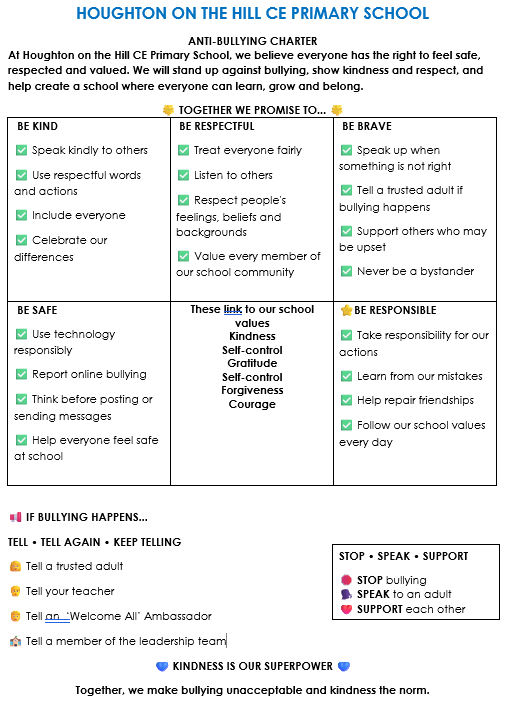
Please see our Anti-Bullying statement for further information. This can be found on our Policy Page.
Responding to Allegations of Bullying
All allegations of bullying will be acknowledged promptly and investigated without delay.
Serious concerns will be reviewed by a senior leader on the same working day wherever possible.
When an allegation is received, a senior member of staff will:
- Listen carefully and take the concern seriously.
- Gather information from all parties involved.
- Speak with any witnesses.
- Review available evidence.
- Record findings.
- Inform parents or carers where appropriate.
- Determine whether the behaviour constitutes bullying.
- Implement support and sanctions where necessary.
- Monitor outcomes to prevent recurrence.
The school will adopt a proportionate, fair and evidence-based response.
Support for Victims
The school will provide support appropriate to individual need which may include:
- A named member of staff responsible for monitoring and supporting the pupil.
- Regular wellbeing check-ins.
- Restorative conversations where appropriate.
- Friendship support.
- ELSA support.
- SEND support.
- Risk assessment and safety planning.
- Pastoral support.
- Referral to external agencies where appropriate.
Pupils will be reassured that:
- Their concerns have been heard.
- Appropriate action is being taken.
- They will be supported throughout the process.
Support for Pupils Displaying Bullying Behaviour
The school recognises that bullying behaviour may indicate unmet social, emotional or behavioural needs.
Support may include:
- Restorative approaches.
- Reflection and educational activities.
- Behaviour support plans.
- Daily monitoring systems.
- Parent meetings.
- Mentoring.
- Social skills interventions.
- Referral to external agencies where appropriate.
The school will work with families to secure sustained improvements in behaviour wherever possible.
Sanctions
Confirmed bullying is regarded as serious misconduct.
Sanctions may include:
- Loss of break or lunchtime privileges.
- Removal from class or activities.
- Formal communication with parents.
- Exclusion from areas or activities.
- Lunchtime exclusion.
- Fixed-term suspension.
- Permanent exclusion in the most serious circumstances and in accordance with statutory guidance.
The school reserves the right to apply sanctions proportionate to the severity and impact of the behaviour.
Cyberbullying and Online Behaviour
The school recognises that bullying can occur through:
- Social media.
- Messaging applications.
- Online gaming.
- Websites.
- Email.
- Mobile technology.
Parents and pupils will be encouraged to retain screenshots, messages and other evidence to support investigations into online bullying.
The school reserves the right to investigate and respond to incidents occurring outside school where the behaviour impacts upon:
- The safety of pupils.
- The wellbeing of pupils.
- The education of pupils.
- Relationships within the school community.
- The reputation of the school.
Where appropriate, the school will:
- Work in partnership with parents.
- Preserve evidence.
- Liaise with online providers.
- Apply sanctions in accordance with school policies.
- Refer safeguarding concerns to the DSL.
This section should be read alongside the school's Online Safety Policy.
Preventing Bullying
The school is committed to creating a culture in which bullying is unlikely to occur.
We will:
- Review this policy annually.
- Consult with pupils, staff, governors and parents.
- Maintain a pupil Anti-Bullying Charter.
- Train and support Pupil ‘Welcome All’ Ambassadors.
- Display anti-bullying information prominently across the school.
- Include anti-bullying messages in newsletters and communications.
- Maintain anti-bullying information on the school website.
- Participate in Anti-Bullying Week annually.
- Deliver a high-quality PSHE curriculum.
- Promote British Values and Christian Values.
- Challenge prejudice, stereotypes and discrimination.
- Provide regular staff and governor training.
- Provide specific training for lunchtime staff and support staff.
- Regularly seek pupil views through surveys, discussions and ambassador groups.
- Use pupil voice to evaluate the effectiveness of anti-bullying measures.